Loading breed
Landseer
Health grade CThe Landseer is a gentle, confident giant—bred as an imposing water rescue dog and calm guardian that acts with immense strength, but without aggression. A dog that prefers to rest until it is truly needed.
- Height67–80 cm
- Weight45–80 kg
- Life expectancy10–12 yrs
- Puppy price2,000–3,500 €
- Energy4/5
The Essentials at a Glance
The Landseer is a gentle, confident giant—bred as an imposing water rescue dog and calm guardian that acts with immense strength, but without aggression. A dog that prefers to rest until it is truly needed.
- Health grade C: The Landseer receives a grade of C because, as a very large breed, it is prone to typical musculoskeletal issues.
- You live on the ground floor with access to a garden—climbing stairs is not an option for this 70-kilo dog in the long run.
- You don't mind wetness and dirt in the house, because his heritage as a water rescue dog means he won't pass up a lake or a puddle.
- You expect a dog that shines on the training field and obeys instantly—he was bred to act independently in the water, not for quick obedience.
Is the Landseer right for you?
At a glance
Landseer overview
The essentials — key facts, traits, and health priorities — before you dive deeper.
Health grade
Relative to other breeds
S
A
B
C
D
E
Very healthyHigher risk
Average — several important tests are expected.
See full health info & tests →
Note: This health overview is AI-assisted and editorially reviewed. It is for orientation only and does not replace veterinary advice.
Lifespan
10–12 yrs
Height
67–80 cm
Weight
45–80 kg
Practical
- Puppy price: 2,000 – 3,500 €
- Coat: Dense, water-repellent, undercoat
- Origin: Germany, Switzerland
Temperament
Energy
Trainability
Family fit
With kids
Daily life
Care effort
Shedding
Barking
City-friendly
Guard instinct
What matters most
Especially with a Landseer, choosing the right breeder is the single most important decision you'll make. Serious breeders consistently test the parents for inherited conditions, prioritize healthy early socialization, and stay accountable long after handover. A cheap puppy without health screening tends to become the most expensive dog later on.
See HonestDog breeder standards →Colors & coat
What colors does the Landseer come in?
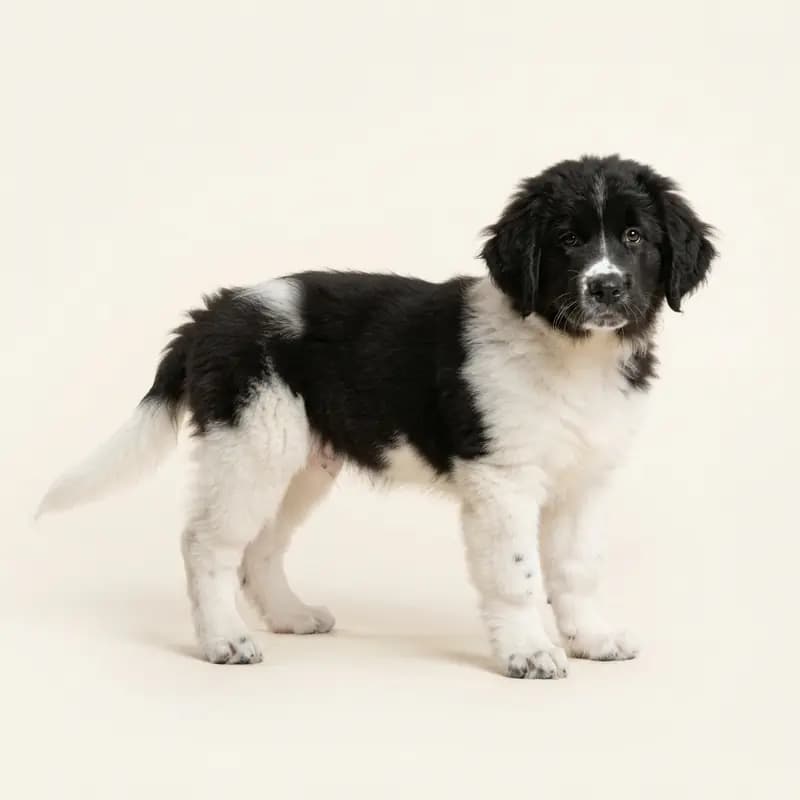
The coat colors you will see in Landseer litters — including which ones fall outside the breed standard and which carry genetic risk.
Eye colors
 Brown
Brown
Coat type
 Long
Long Double coat
Is the Landseer right for you?
The Landseer is a gentle, confident giant—bred as an imposing water rescue dog and calm guardian that acts with immense strength, but without aggression. A dog that prefers to rest until it is truly needed.
Perfect for you if:
- You live on the ground floor with access to a garden—climbing stairs is not an option for this 70-kilo dog in the long run.
- You don't mind wetness and dirt in the house, because his heritage as a water rescue dog means he won't pass up a lake or a puddle.
- You lead with calm authority rather than drill—as a molosser, he often weighs commands calmly before executing them.
- You are looking for a steady-nerved, extremely patient companion who remains absolutely stoic in the hustle and bustle of family life.
Less ideal if:
- You expect a dog that shines on the training field and obeys instantly—he was bred to act independently in the water, not for quick obedience.
- You are very fussy about your interior—where a wet Landseer shakes himself, mud flies all the way to the walls.
- You are looking for an enduring partner for jogging or cycling, especially on warm days.
- You drive a small car and have a tight budget—everything about this dog, from food to his bed, is XXL.
The real vibes check
A Landseer is not a dog that constantly wants to please you—he is more like a stoic retired lifeguard who observes the action calmly from the corner of his eye. When everything is peaceful, he lies massively in the way, but if someone goes into the water, he mobilizes unstoppable power in seconds. You won't get a blind order-follower, but a magnanimous, often wet protector.
Self-check
Would the Landseer really fit your life?
Answer 6 quick questions about your everyday life and see how well the Landseer fits you — including an honest cost estimate per month, per year, and across the dog's lifetime.
Fit checkCost estimateRisk dice
Takes about 1 minute · free & anonymous
Breed Profile
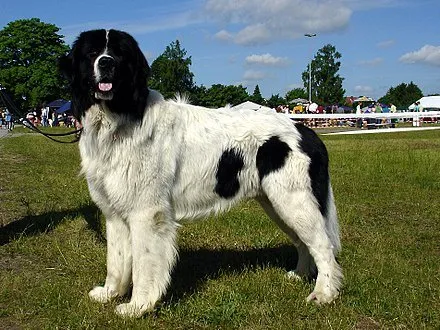
The Landseer's impressive appearance can be intimidating at first glance, but don't let their size fool you - these dogs are loving, gentle giants. They belong to FCI Group 2, to the Pinschers and Schnauzers, Molossoids, Swiss Mountain Dogs and other dog breeds. Landseers are harmoniously built, large and strong dogs. They have a beautiful, dense and water-repellent coat that is primarily white, with distinctive black markings. Her head is wide and massive, and her dark eyes radiate an immense gentleness. Although all Landseers are uniform in their color scheme and size, there is a subtle distinction between the working and show lines. Working lines are often slightly more robustly built and have more stamina, while show lines tend to have a slightly more pronounced coat and a more dramatic head.
All measurements in detail
- Height
- 67 - 72 cm (Female), 72 - 80 cm (Male)
- Weight
- 45 - 55 kg (Female), 60 - 80 kg (Male)
- Life Expectancy
- 10 - 12 yrs
- Character
- Gentle, loyal, child-friendly
- Coat
- Dense, water-repellent, undercoat
- Coat Color
- White with black markings
- Price
- 2000 - 3500 €
Character & Temperament
Landseers are balanced, good-natured and friendly dogs that are known for their love of people, especially children. Their gentle and patient nature makes them excellent family dogs. They are extremely people-oriented and love being part of the family. Their loyalty and protectiveness are unmatched without being aggressive. Instead, they are vigilant and proceed with remarkable calm and composure. In general, Landseers are active dogs, although they are not hyperactive. They need daily exercise and mental stimulation to be healthy and happy, but they are also content to relax at home as long as they are near their humans. Despite their size, they can easily adapt to living in an apartment as long as they get enough exercise. Landseers are good at learning to stay alone, but they should not be left alone for long periods of time as they tend to develop separation anxiety. Your need for human companionship should not be underestimated. Although they have a slight hunting instinct, it is rather weak compared to many other breeds. However, they may feel the urge to investigate at the sight of small animals or the smell of game. However, with good socialization and training, this can be well managed. In terms of their temperament and potential uses, it is remarkable that the Landseer has retained its original working instincts. They are excellent swimmers and are often used as water rescue dogs. Her calm and sensitive nature, combined with her strength and endurance, makes her ideal for this work. In addition, they are also good therapy and assistance dogs, thanks to their sensitivity and their ability to respond to the emotions of their people. Regardless of whether you are looking for a Landseer for work, as a family dog or just as a companion, you will find in him a loving, loyal and reliable friend. They are real heart dogs who love being with their people and bringing them joy. With a Landseer at your side, you not only have an impressive dog, but also a friend for life.
| Trainability Bred to work closely alongside humans. | Highly trainable |
| Watchfulness Reports unusual activity but stays controlled. | Moderate |
| Openness to Strangers Warms up quickly and is generally welcoming. | Friendly |
| Hunting or Herding Drive Mild interest in movement and small animals — easily managed. | Low |
Fun Fact!
Landseer dogs are named after the British painter Sir Edwin Landseer, who depicted them in many of his works.
What Awaits You
Landseers love the water and are often used in water rescue. Like all large dogs, you need to watch out for hereditary diseases such as joint problems.
Housing & Care
Landseers can adapt well to life in the city as long as they get enough exercise and mental stimulation. Their calm and laid-back nature makes them good city dogs, but they require regular access to open spaces to exercise. They get along well with small children and are known for their patience and kindness towards them. They are also usually friendly with other pets, including cats, as long as they are properly socialized.
- Family Friendly
Lives for its family — the born family companion.
Ideal family dog - Child Friendly
Extraordinarily patient and loving — a true family dog.
Excellent with children - Dog Friendly
Actively enjoys the company of other dogs.
Dog-friendly - City Friendly
City-appropriate with enough exercise and stimulation.
Manageable in cities
Owning a dog is a privilege, but it's also a real responsibility. Before you bring one into your life, be honest with yourself about the commitment it takes.
Training & Education
Landseers are intelligent and willing to work dogs that are easy to train. They respond best to positive reinforcement and gentle, consistent methods. They can be trained for various dog sports, such as water work or search and rescue. Because they were originally bred to be working dogs, they need something to do to be happy. However, you should be careful not to overwork them as this can lead to stress. This breed doesn't tend to be a "ball junkie." but they enjoy games that utilize their mental abilities and natural instincts. Frustration tolerance and impulse control training can be particularly useful for improving their patience and ability to self-control. They are often willing and able to learn new tasks and tricks, making them a pleasure to work with.
Nutrition & Care
Landseers are active dogs and therefore require a balanced and nutritious diet that meets their energy needs. It is important to watch calorie intake to avoid becoming overweight, as this can put additional stress on their joints. A diet high in protein and sufficient fiber is recommended. Because they are prone to gastroenteritis, they should be given smaller meals throughout the day and allowed to rest after meals before returning to activity. The Landseer's coat care is quite intensive due to its dense, water-repellent fur, which has an undercoat. They shed heavily, especially during the spring and fall seasons, and therefore require regular brushing to remove dead hair and keep skin healthy. They cope well with the climate in Germany as their fur protects them from both cold and heat, although they should be protected from overheating in summer.
| Care Level Regular brushing and occasional professional grooming. | Moderate |
| Exercise Needs Needs several hours of serious exercise every day. | Very active |
| Shedding Regular shedding — dog hair on clothes is now normal. | Moderate |
| Trainability Bred to work closely alongside humans. | Highly trainable |
Our experts are still reviewing this information. Spotted something wrong? Email us at info@honestdog.de.
Health & hereditary diseases
Health
C
Solid, watch carefully
Health grade
The Landseer receives a grade of C because, as a very large breed, it is prone to typical musculoskeletal issues. Hip dysplasia (HD) and elbow dysplasia (ED) are known risks that must be managed through strict selective breeding. Additionally, attention should be paid to muscular dystrophy to prevent severe muscle weakness.
Grade is relative to other breeds — AI-assisted and editorially reviewed.
In daily life this can mean
During the first year of life, you should pay strict attention to adapted nutritional management and joint-friendly exercise to avoid overly rapid growth and later bone problems.
The breeder's role
Reputable breeders have the hips, elbows, shoulders, and hearts of the parent animals checked and use genetic testing for metabolic and blood clotting disorders to reduce risks in the lineage.
Note: This health overview is AI-assisted and editorially reviewed. It is for orientation only and does not replace veterinary advice.
No Health Tests Available
No specific health tests are currently available for this breed.
Costs & where to find one
How much does a Landseer cost?
A Landseer costs around ~€240 per month (€130 – €470, depending on your setup). The first year adds up to roughly ~€6,480 including purchase, equipment and puppy school; across the dog's life (11 years) it comes to about ~€35,480.
With surgery cover, running costs come to about ~€250 per month — in return, your share of a major operation drops from several thousand euros to around 20 percent.
Per month
~€240
In the first year
~€6,480
Across the dog's life
~€35,480
Purchase from a breeder: €2,000 – €3,500
Estimate at a mid-range setup (suburban, dry food, 1–2 hours of daily exercise), average German prices, as of July 2026.
Calculate your personal costs1-minute self-check with your own answers
Looking for a Landseer?
Appearance, variants & origin
History
The full history
The historical roots of the Landseer are closely intertwined with those of the Newfoundland. These large, water-loving dogs originally hail from the Canadian island of Newfoundland, where they were employed by local fishermen as robust working dogs. Their initial tasks included retrieving fishing nets, pulling heavy loads, and water rescue. In the late 18th and early 19th centuries, British sailors brought these striking black-and-white dogs to England, where they quickly gained great popularity among the nobility and the upper class. The breed owes its current name to the renowned British animal painter Sir Edwin Henry Landseer, who immortalized these imposing dogs in numerous works during the mid-19th century, thereby making them famous throughout Europe. While the black-and-white type was eventually classified merely as a color variant of the Newfoundland in Great Britain and North America, cynologists in Germany and Switzerland began targeted purebred breeding at the beginning of the 20th century. They developed the so-called European-continental type, which is distinguished from the bulkier Newfoundland by its longer legs and more agile stature. Due to this independent breeding development in Germany and Switzerland, the Landseer was officially recognized as a distinct breed by the Fédération Cynologique Internationale (FCI) in 1960.
Original Use
The Landseer was bred as a water rescue dog and is renowned for its ability to save people from the water.
Origin
Germany, Switzerland
Date
1900
Owner experiences
What owners say about the Landseer
Michael S., Halter aus Thüringen (Rüde, verstarb mit 11 Jahren)
Unser Rüde war ein absoluter Traumhund – gelassen, souverän und unglaublich verschmust. Wer allerdings einen leichtführigen Hund sucht, der sofort pariert, ist beim Landseer falsch. Man darf sie nicht mit einem Schäferhund vergleichen. Sie haben ihren eigenen Kopf, sind manchmal ziemlich dickköpfig und hinterfragen Kommandos gerne mal mit einer charmanten Sturheit.
Ein riesiges Thema im Alltag ist die Fellpflege. Wenn der Fellwechsel ansteht, verliert er gefühlt tonnenweise Haare. Ohne einen wirklich leistungsstarken Staubsauger ist man im Haus absolut verloren. Man bürstet und bürstet, und direkt danach fliegen schon wieder die nächsten Flusen durch die Gegend.
Leider mussten wir uns auch mit den gesundheitlichen Risiken der Rasse auseinandersetzen. Während seine Knochen bis zum Schluss topfit waren, machten sich ab dem fünften Lebensjahr erste Anzeichen von Schlappheit bemerkbar. Nach der Diagnose Mitralklappeninsuffizienz (ein Herzfehler) mussten wir ihn medikamentös einstellen lassen. Er wurde am Ende elf Jahre alt, was für diese Größe ein schönes Alter ist, aber man sollte die Herzgesundheit bei dieser Rasse definitiv von Anfang an im Auge behalten.
Sabine T., Halterin aus Bayern (Rüde, seit 2021)
Unser Landseer ist der größte Schoßhund der Welt – zumindest glaubt er das selbst. Mit seinen über 60 Kilo liegt er mit Vorliebe immer genau dort, wo er maximal im Weg liegt. Wenn man staubsaugen oder wischen will, bewegt er sich keinen Millimeter. Er lässt sich beim Putzen lieber absaugen und genießt die rotierende Bürste.
Man darf bei dieser Rasse absolut nicht penibel sein, was Sauberkeit angeht. Seine Pfoten sind riesig und nach jedem Spaziergang im Regen trägt er gefühlt den halben Wald ins Haus. Wischmop und Handtücher sind bei uns im Dauereinsatz. Zudem hat er dieses unglaubliche Talent, einen genau dann mit der Nase am Arm anzustupsen, wenn man eine randvolle Kaffeetasse in der Hand hält und gedanklich ganz woanders ist.
Trotz seiner Intelligenz entscheidet er im Alltag oft sehr eigenständig, welche Kommandos er gerade für sinnvoll erachtet. Er ist außerdem ein großartiger Schauspieler: Wenn er mal keine Lust auf Übungen hat, kann er plötzlich so tun, als würde er humpeln – kaum sind wir wieder auf dem Heimweg, ist alles vergessen. Aber seine tiefe, treue Art macht jeden Dreckfleck sofort wieder wett.
Anja M., Halterin aus Niedersachsen (Hündin, seit 2022)
Ich hatte mich auf den typischen, leicht erziehbaren Familienhund gefreut, wurde im Alltag aber schnell eines Besseren belehrt. Unsere Hündin ist extrem eigensinnig und stur. Unterwegs interessiert sie sich oft nur für andere Hunde, und herkömmliche Erziehungsmethoden mit Leckerlis prallen an ihr völlig ab. Sie ist trotz ihrer enormen Größe unglaublich sensibel – wird man zu streng oder laut, macht sie komplett dicht. Man braucht unendlich viel Geduld und eine sehr konsequente, aber liebevolle Hand.
Was wir auch unterschätzt haben, ist ihr ausgeprägter Sinn für das 'Rudel'. Am liebsten läuft sie nur, wenn die gesamte Familie gemeinsam spazieren geht. Fehlt jemand, merkt man ihr die Unruhe und Unlust richtig an.
Lustigerweise hat sie das typische 'Wasserhund-Gen' wohl übersprungen. Während man überall liest, dass Landseer geborene Rettungsschwimmer sind, wollte unsere Maus anfangs absolut nichts vom nassen Element wissen. Mehr als die Pfoten abzukühlen war im ersten Jahr nicht drin. Erst jetzt, mit über zwei Jahren, fängt sie langsam an, freiwillig ein bisschen zu planschen.
Paraphrased from real owner reports
Loading owner stories
Community Posts
FAQ & more
Frequently asked questions about the Landseer
Is a Landseer the right dog for me?
The Landseer is an active dog that needs plenty of exercise and mental stimulation. Research the temperament, grooming needs, and space requirements before deciding.
How long does a Landseer live?
The average life expectancy of a Landseer is 10-12 years. With proper care and regular vet visits, your dog can live a long, healthy life.
How much grooming does a Landseer need?
Landseer grooming requirements include regular brushing, nail trimming, and dental care. HonestDog provides detailed grooming tips for every breed.
Is a Landseer good for families with children?
The Landseer can be a great family dog. Proper training and socialization are key. HonestDog provides family suitability information for every breed.
What colors does the Landseer come in?
The Landseer comes in these colors: Black and white.
Loading related articles
Are you a Landseer breeder?
Showcase your kennel on HonestDog and reach families searching for a responsibly bred Landseer.
Why HonestDog?
What makes HonestDog different from other platforms
Full transparency
We lay out what we have: who the breeder is, how they work, and any health records they've uploaded. So you can judge for yourself.
Responsible breeding, assured
Every breeder on HonestDog has their identity and documents checked before their profile goes live. Health records they upload are shown on the profile, so you can see exactly what has been tested.
Trust and verification
We verify breeders and buyers alike, so every conversation happens on solid ground. It's a new standard of trust in dog breeding.
Less hassle, more time
We've already checked the breeders' documents and gathered the details, so you can skip the endless research and focus on finding the right puppy for your family.
Our Mission

We connect dog lovers with responsible breeders and shelters to ensure every dog finds the perfect home.
Founded by dog enthusiasts, our platform focuses on ethical dog breeding and adoption.
Why HonestDog?
We connect you with vetted breeders and shelters so you can find your — your new companion — with confidence.
Vetted Partners
Only verified breeders and shelters — for a safe start.
Highest Standards
Every animal's health and wellbeing is our top priority.
Guides & Resources
Guides, checklists, and breed profiles — so you can make a well-informed decision.