Loading breed
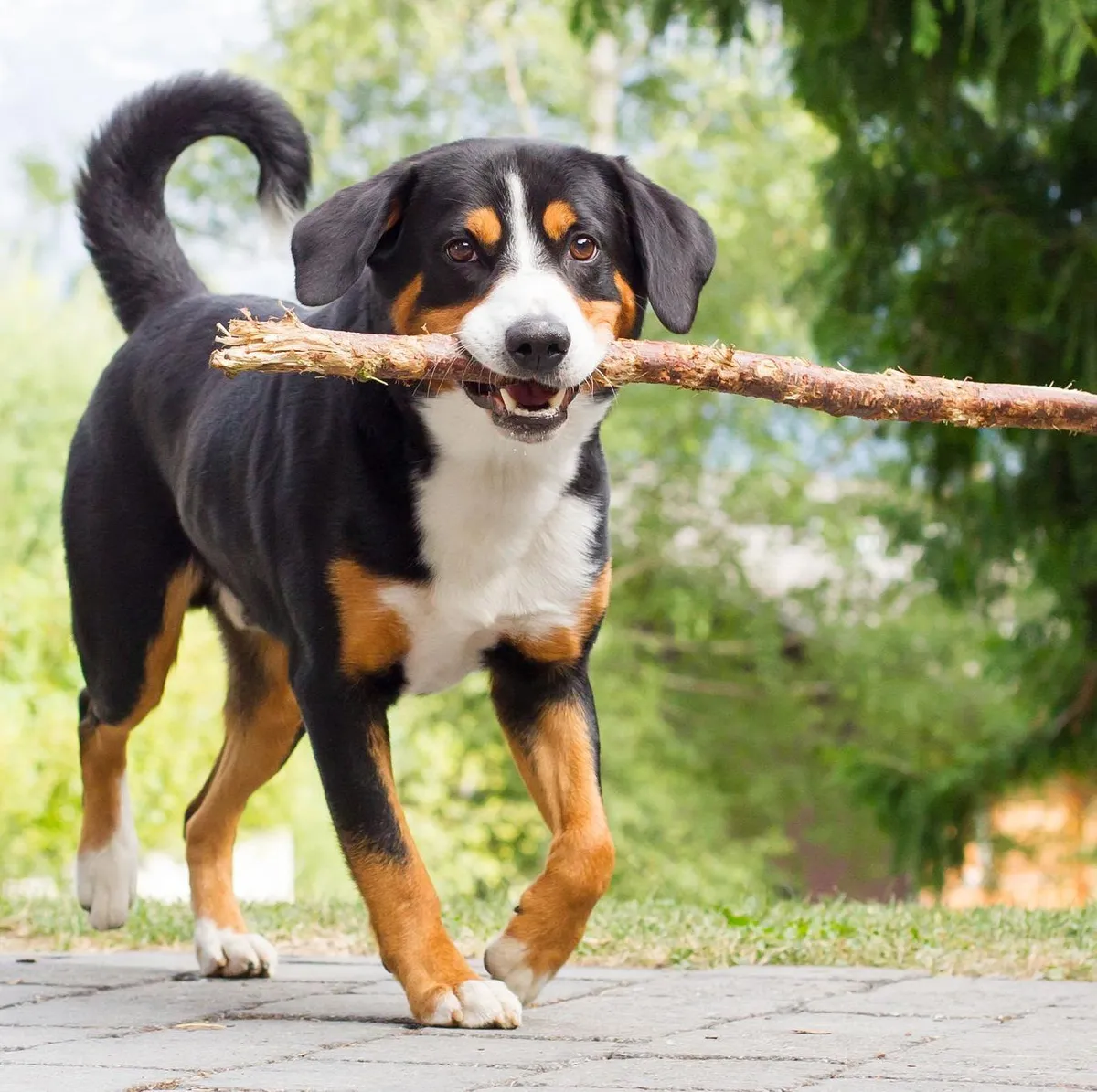
Appenzell Mountain Dog
Health grade CThe Appenzeller Sennenhund is a lightning-fast, vocal herding and guard dog—bred to tirelessly drive cattle herds in the Alps and loudly guard the family farm. This concentrated energy still looks for a real job to do today.
- Height50–56 cm
- Weight22–32 kg
- Life expectancy12–14 yrs
- Puppy price1,000–2,500 €
- Energy5/5
The Essentials at a Glance
The Appenzeller Sennenhund is a lightning-fast, vocal herding and guard dog—bred to tirelessly drive cattle herds in the Alps and loudly guard the family farm. This concentrated energy still looks for a real job to do today.
- Health grade C: The Appenzeller Sennenhund is a very robust breed, with the breeding association successfully monitoring hip dysplasia (HD) through mandatory health tests.
- You provide him with a solid substitute task like agility, Treibball, or search and rescue work—a simple walk will never tire out this hardware.
- You ideally live in a rural area and have a garden or yard where his territorial streak can find space.
- You live in a thin-walled apartment—as a classic farm guardian, he will announce every change loudly and persistently; that is his genetics.
Is the Appenzell Mountain Dog right for you?
At a glance
Appenzell Mountain Dog overview
The essentials — key facts, traits, and health priorities — before you dive deeper.
Health grade
Relative to other breeds
S
A
B
C
D
E
Very healthyHigher risk
Average — several important tests are expected.
See full health info & tests →
Note: This health overview is AI-assisted and editorially reviewed. It is for orientation only and does not replace veterinary advice.
Lifespan
12–14 yrs
Height
50–56 cm
Weight
22–32 kg
Practical
- Puppy price: 1,000 – 2,500 €
- Coat: Dense, smooth, with an undercoat
- Origin: Switzerland
Temperament
Energy
Trainability
Family fit
With kids
Daily life
Care effort
Shedding
Barking
City-friendly
Guard instinct
What matters most
Especially with a Appenzell Mountain Dog, choosing the right breeder is the single most important decision you'll make. Serious breeders consistently test the parents for inherited conditions, prioritize healthy early socialization, and stay accountable long after handover. A cheap puppy without health screening tends to become the most expensive dog later on.
See HonestDog breeder standards →Colors & coat
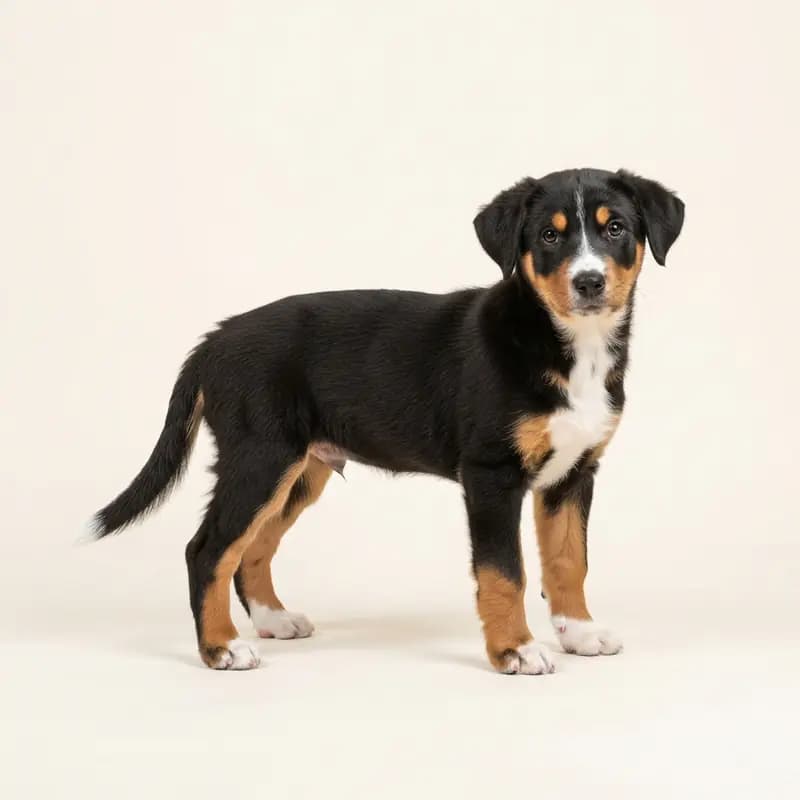
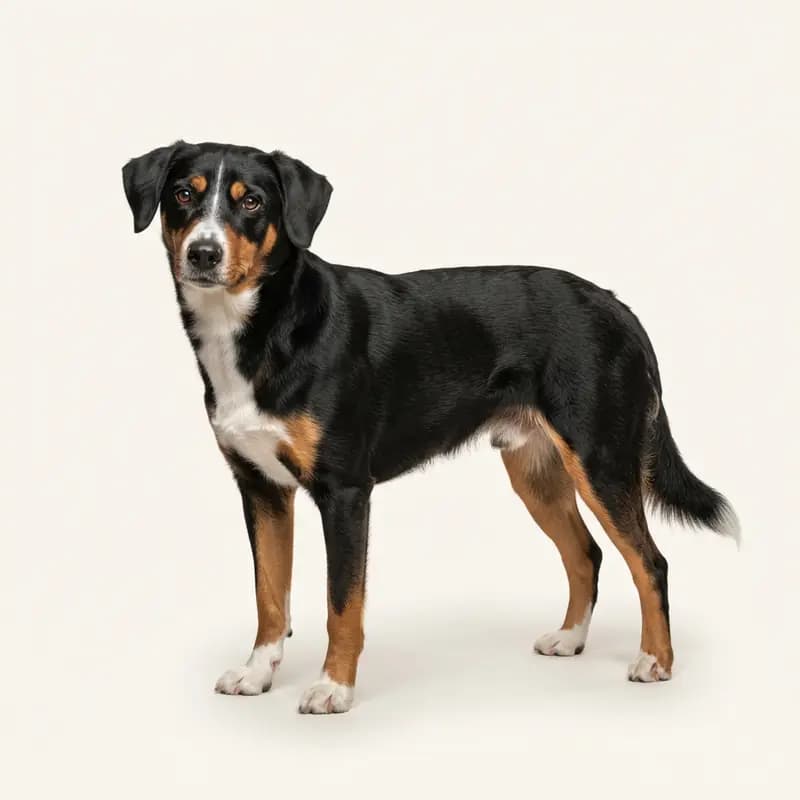
What colors does the Appenzell Mountain Dog come in?
The coat colors you will see in Appenzell Mountain Dog litters — including which ones fall outside the breed standard and which carry genetic risk.
Eye colors
 Brown
Brown
Coat type
 Short
Short Double coat
Is the Appenzell Mountain Dog right for you?
The Appenzeller Sennenhund is a lightning-fast, vocal herding and guard dog—bred to tirelessly drive cattle herds in the Alps and loudly guard the family farm. This concentrated energy still looks for a real job to do today.
Perfect for you if:
- You provide him with a solid substitute task like agility, Treibball, or search and rescue work—a simple walk will never tire out this hardware.
- You ideally live in a rural area and have a garden or yard where his territorial streak can find space.
- You lead with confidence and consistency so that his innate suspicion of strangers does not turn into uncontrollable controlling behavior.
- You love being outdoors in any weather and are looking for a robust partner for hours of hiking.
Less ideal if:
- You live in a thin-walled apartment—as a classic farm guardian, he will announce every change loudly and persistently; that is his genetics.
- You expect a dog that is happy to see every visitor and lets strangers pet him immediately.
- You have little time for mental stimulation and hope that he will sleep peacefully on the sofa after an hour of walking.
- You are a dog novice and get unsettled by a physically active, quick-reacting dog.
The real vibes check
An Appenzeller Sennenhund is not a relaxed sidekick, but the self-appointed shift supervisor of your daily life who keeps an eye on everything and comments on it. If you channel this tireless work ethic into clear paths, you will get an unconditionally loyal partner. However, if you leave the decisions to him, he will regulate your life and your visitors more strictly than a bouncer.
Self-check
Would the Appenzell Mountain Dog really fit your life?
Answer 6 quick questions about your everyday life and see how well the Appenzell Mountain Dog fits you — including an honest cost estimate per month, per year, and across the dog's lifetime.
Fit checkCost estimateRisk dice
Takes about 1 minute · free & anonymous
Breed Profile
The Appenzeller Mountain Dog is a medium-sized, muscular and powerfully built dog. His appearance conveys the impression of agility and endurance. The head is powerful, with a pronounced stop and medium-long lopsided ears. The eyes are small, almond-shaped and have an attentive expression. The tail is long and is often carried arched over the back. The Appenzeller Mountain Dog belongs to FCI Group 2 and is one of the four mountain dogs, which also include the Bernese Mountain Dog, the Greater Swiss Mountain Dog and the Entlebucher Mountain Dog. The Appenzellers do not differentiate between performance and show lines.
All measurements in detail
- Height
- 50 - 54 cm (Female), 52 - 56 cm (Male)
- Weight
- 22 - 32 kg (Female), 25 - 32 kg (Male)
- Life Expectancy
- 12 - 14 yrs
- Character
- Attentive, eager to work, loyal
- Coat
- Dense, smooth, with an undercoat
- Coat Color
- Black or Havana brown with rust or white-brown markings
- Price
- 1000 - 2500 €
Character & Temperament
The Appenzeller Mountain Dog is a hard-working and attentive dog with a strong drive to herd. Traditionally a farm dog, he feels most comfortable when he has chores to do, especially outdoors. The herding disposition is strong in this breed and should be taken into account if you are considering keeping an Appenzeller as a family dog. He is not a dog that likes to laze around and needs an active lifestyle with enough mental and physical activity. An Appenzeller who is bored may develop destructive behavior. However, if you enjoy being out in nature and are looking for a loyal companion for long walks or hikes, the Appenzeller could be just the thing for you. The Appenzeller is very people-oriented and forms a deep bond with his family. He is also alert and can be suspicious of strangers, making him an effective guard dog. However, with appropriate socialization and habituation, he can learn to deal with new people and situations in a more relaxed manner. He also has a playful personality, which makes him a fun family member. The Appenzeller is intelligent and learns quickly, which makes training easier. However, he is sometimes a little stubborn and therefore needs clear leadership. Because of its herding instincts, the Appenzeller Mountain Dog is prone to a certain degree of hunting behavior, so it is important to train and control it well from the start, especially in the presence of smaller animals. He can learn to stay alone, but as a dog that is closely bonded with his family, this should not be done for long periods of time. If you take the time to properly train this wonderful dog and give him the love and attention he needs, he will be an incredibly loyal and faithful companion.
| Trainability Bred to work closely alongside humans. | Highly trainable |
| Watchfulness A natural watchdog with real protective instinct. | High |
| Openness to Strangers Neither pushily friendly nor suspicious. | Neutral |
| Hunting or Herding Drive Noticeable drive — needs attention around small animals. | Moderate |
Fun Fact!
The Appenzeller Mountain Dog is one of four mountain dog breeds that originate from Switzerland and is often referred to as the "cheerful character" among Swiss Mountain Dogs!
What Awaits You
Appenzell Mountain Dogs are considered lively and headstrong dogs. They are easy to train and are often described as unsure of the unknown.
Housing & Care
The Appenzeller Mountain Dog is not particularly suitable for keeping in cities as it needs a lot of exercise and activity. A house with a large garden would be ideal. Small children are usually not a problem for the Appenzell Mountain Dog as long as they treat the dog with respect. The Appenzeller can also get along with cats and other pets if he is accustomed to them from an early age.
- Family Friendly
Loves family life and thrives in a group.
Family-oriented - Child Friendly
Extraordinarily patient and loving — a true family dog.
Excellent with children - Dog Friendly
Actively enjoys the company of other dogs.
Dog-friendly - City Friendly
City-appropriate with enough exercise and stimulation.
Manageable in cities
Owning a dog is a privilege, but it's also a real responsibility. Before you bring one into your life, be honest with yourself about the commitment it takes.
Training & Education
The Appenzell Mountain Dog is intelligent, eager to learn and willing to work. It is well suited for various dog sports such as agility, obedience or protection work. It's important to start training early and stay consistent. The Appenzeller Mountain Dog has a high level of energy and needs a lot of activity, but you should be careful not to let him become "over-busy" as this can lead to stress. There is a risk that the Appenzeller Mountain Dog will become a ball junkie if he plays with balls too often and too intensively. Frustration tolerance and impulse control are important aspects of education. It is important to teach the dog to stay calm sometimes and not to be constantly in action. Since the Appenzeller Mountain Dog is originally a herding dog, you should offer him alternatives to meet his natural instincts without causing him to develop undesirable behavior. This can be done through intelligence toys, nose work, or special training exercises.
Nutrition & Care
The Appenzeller Mountain Dog requires a balanced diet that is rich in nutrients to support its active lifestyle. High-quality dog food suitable for medium-sized and active dogs is recommended. Additionally, fresh fruits and vegetables can be given in moderate amounts. It is important to be careful not to allow the dog to become overweight as this can place additional stress on the joints. The Appenzeller Mountain Dog has a dense coat with an undercoat. The fur is weatherproof and he usually copes well with the climate in Germany. He sheds moderately and requires regular brushing to remove dead hair and prevent tangles.
| Care Level Minimal effort — occasional brushing and bathing. | Low-maintenance |
| Exercise Needs Working-dog energy that needs burning off every single day. | High-drive |
| Shedding Hair everywhere, always — no white clothing survives. | Very heavy |
| Trainability Bred to work closely alongside humans. | Highly trainable |
Our experts are still reviewing this information. Spotted something wrong? Email us at info@honestdog.de.
Health & hereditary diseases
Health
C
Solid, watch carefully
Health grade
The Appenzeller Sennenhund is a very robust breed, with the breeding association successfully monitoring hip dysplasia (HD) through mandatory health tests. Prospective buyers should still keep an eye on elbow dysplasia (ED) and the breed-specific ectopic ureter (a malformation of the ureters) to rule out potential joint and bladder issues. Overall, however, the breed shows a pleasingly low genetic disease burden.
Grade is relative to other breeds — AI-assisted and editorially reviewed.
In daily life this can mean
You should pay attention to a healthy weight and joint-friendly exercise, as well as schedule regular eye check-ups so that your dog remains active for a long time.
The breeder's role
Reputable breeders have the hips, elbows, knees, and eyes of the parent animals strictly tested to specifically reduce health risks in the line.
Note: This health overview is AI-assisted and editorially reviewed. It is for orientation only and does not replace veterinary advice.
No Health Tests Available
No specific health tests are currently available for this breed.
Costs & where to find one
How much does a Appenzell Mountain Dog cost?
A Appenzell Mountain Dog costs around ~€180 per month (€100 – €350, depending on your setup). The first year adds up to roughly ~€4,780 including purchase, equipment and puppy school; across the dog's life (13 years) it comes to about ~€31,160.
With surgery cover, running costs come to about ~€190 per month — in return, your share of a major operation drops from several thousand euros to around 20 percent.
Per month
~€180
In the first year
~€4,780
Across the dog's life
~€31,160
Purchase from a breeder: €1,000 – €2,500
Estimate at a mid-range setup (suburban, dry food, 1–2 hours of daily exercise), average German prices, as of July 2026.
Calculate your personal costs1-minute self-check with your own answers
Looking for a Appenzell Mountain Dog?
Appearance, variants & origin
History
The full history
The origins of the Appenzeller Mountain Dog can be traced back to the early Middle Ages, although it is likely that the breed descended from the Molosser dogs that were brought to Switzerland by the Romans. The Appenzeller was originally used in the Swiss Alps as a herding and driving dog for cows. It was also used as a guard dog on farms and for pulling small carts. The breed was not recognized as a separate breed until the late 1800s. Albert Heim, a well-known cynologist, played a key role in saving and standardizing the breed. In 1898 the Swiss Appenzeller Mountain Dog Club was founded and in 1989 the Appenzeller Mountain Dog was officially recognized by the F"d"ration Cynologique Internationale (FCI).
Original Use
The Appenzeller Mountain Dog was used as a versatile farm dog for herding livestock, pulling carts and as a guard dog.
Origin
Switzerland
Date
1800
Owner experiences
What owners say about the Appenzell Mountain Dog
Zusammengefasst aus öffentlich geteilten Halter-Erfahrungen
Im Alltag zeigt sich der Appenzeller Sennenhund als treuer und extrem menschenbezogener Begleiter, der am liebsten jede Sekunde mit seiner Familie verbringt. Viele Halter berichten von einer tiefen, fast unerschütterlichen Bindung zu ihren Bezugspersonen. Im Haus gelten sie oft als angenehme und verschmuste Mitbewohner, sofern sie ausgelastet sind.
Allerdings weisen erfahrene Besitzer immer wieder darauf hin, dass die rassetypische Wachsamkeit und das Misstrauen gegenüber Fremden nicht unterschätzt werden dürfen. Ein Appenzeller ist kein Hund, der jeden Besucher schwanzwedelnd begrüßt. Ohne konsequente Führung neigen viele Tiere dazu, das eigene Grundstück vehement zu verteidigen und Besucher oder Passanten lautstark zu verbellen.
Ein weiterer kritischer Punkt in Erfahrungsberichten ist der ausgeprägte Hüteinstinkt. In Familienforen wird berichtet, dass nicht ausgelastete oder unzureichend erzogene Hunde dazu neigen, rennende Kinder, Fahrräder oder andere Tiere zu hüten, was sich im schlimmsten Fall durch das typische „Hacken“ (Zwicken in die Fersen oder Waden) äußert. Eine frühzeitige, sensible Sozialisierung ist daher für ein harmonisches Familienleben unerlässlich.
Zusammengefasst aus öffentlich geteilten Halter-Erfahrungen
In der Erziehung wird der Appenzeller von Haltern als zweischneidiges Schwert beschrieben. Einerseits ist die Rasse extrem intelligent, lernt neue Kommandos oft innerhalb von Minuten und zeigt eine enorme Arbeitsfreude. Sie eignen sich hervorragend für Hundesportarten wie Agility, Fährtensuche oder als Begleiter am Pferd.
Andererseits erfordert diese Intelligenz eine absolut konsequente und souveräne Führung. Viele Besitzer betonen, dass der Appenzeller jede Inkonsequenz sofort durchschaut und eigene Entscheidungen trifft. Zudem neigt die Rasse bei Unterforderung oder falscher Beschäftigung zu Frustbellen und einer ausgeprägten Hibbeligkeit.
Ein zentraler Ratschlag in Hundeforen lautet daher: „Ruhe lernen“ ist das wichtigste Training für einen jungen Appenzeller. Zu viel Action und ständige Reize führen schnell zu einem überdrehten Hund. Erst durch gezielte Ruhephasen und das Training der Frusttoleranz entwickeln sich die agilen Hunde zu ausgeglichenen Partnern.
Zusammengefasst aus öffentlich geteilten Halter-Erfahrungen
Gesundheitlich gilt der Appenzeller Sennenhund im Vergleich zu anderen Sennenhunden als sehr robust und langlebig. Viele Halter berichten stolz von einer Lebenserwartung von 12 bis 14 Jahren, in Einzelfällen sogar bis zu 17 Jahren. Da sie traditionell auf Leistung und Funktion statt auf reine Optik gezüchtet wurden, sind sie weniger anfällig für viele typische Überzüchtungskrankheiten.
Dennoch weisen Zucht- und Halterberichte auf bestimmte rassetypische Schwachstellen hin. Wie bei vielen mittelgroßen bis großen Rassen können Hüft- und Ellbogendysplasie (HD/ED) sowie Augenerkrankungen (wie Grauer Star oder Bindehautentzündungen im Junghundalter) auftreten. Ein spezifisches, vererbares Problem der Rasse ist zudem der ektone bzw. ektopische Ureter (eine Fehlbildung der Harnleiter), weshalb beim Welpenkauf dringend auf seriöse, geprüfte Züchter geachtet werden sollte.
Beim Thema Ernährung beschreiben Halter ihre Appenzeller oft als leidenschaftliche „Allesfresser“. Sie neigen dazu, extrem verfressen zu sein und alles Erreichbare zu stibitzen. Da sie vor allem nach einer Kastration schnell an Gewicht zulegen, müssen Besitzer die Futtermenge und das Gewicht genau im Auge behalten, um die Gelenke zu schonen.
Paraphrased from real owner reports
Loading owner stories
Community Posts
FAQ & more
Frequently asked questions about the Appenzell Mountain Dog
Is a Appenzell Mountain Dog the right dog for me?
The Appenzell Mountain Dog is an active dog that needs plenty of exercise and mental stimulation. Research the temperament, grooming needs, and space requirements before deciding.
How long does a Appenzell Mountain Dog live?
The average life expectancy of a Appenzell Mountain Dog is 12-14 years. With proper care and regular vet visits, your dog can live a long, healthy life.
How much grooming does a Appenzell Mountain Dog need?
Appenzell Mountain Dog grooming requirements include regular brushing, nail trimming, and dental care. HonestDog provides detailed grooming tips for every breed.
Is a Appenzell Mountain Dog good for families with children?
The Appenzell Mountain Dog can be a great family dog. Proper training and socialization are key. HonestDog provides family suitability information for every breed.
What colors does the Appenzell Mountain Dog come in?
The Appenzell Mountain Dog comes in these colors: Tricolor.
Loading related articles
Are you a Appenzell Mountain Dog breeder?
Showcase your kennel on HonestDog and reach families searching for a responsibly bred Appenzell Mountain Dog.
Why HonestDog?
What makes HonestDog different from other platforms
Full transparency
We lay out what we have: who the breeder is, how they work, and any health records they've uploaded. So you can judge for yourself.
Responsible breeding, assured
Every breeder on HonestDog has their identity and documents checked before their profile goes live. Health records they upload are shown on the profile, so you can see exactly what has been tested.
Trust and verification
We verify breeders and buyers alike, so every conversation happens on solid ground. It's a new standard of trust in dog breeding.
Less hassle, more time
We've already checked the breeders' documents and gathered the details, so you can skip the endless research and focus on finding the right puppy for your family.
Our Mission

We connect dog lovers with responsible breeders and shelters to ensure every dog finds the perfect home.
Founded by dog enthusiasts, our platform focuses on ethical dog breeding and adoption.
Why HonestDog?
We connect you with vetted breeders and shelters so you can find your — your new companion — with confidence.
Vetted Partners
Only verified breeders and shelters — for a safe start.
Highest Standards
Every animal's health and wellbeing is our top priority.
Guides & Resources
Guides, checklists, and breed profiles — so you can make a well-informed decision.