Loading breed

Gordon Setter
Health grade BThe Gordon Setter is an elegant, high-stamina Vorstehhund (pointing dog) — bred to search vast Scottish moors and indicate game by freezing silently in place. This specialization in long-distance work requires refined yet very consistent guidance.
- Height60–68 cm
- Weight23–36 kg
- Life expectancy10–12 yrs
- Puppy price1,500–2,500 €
- Energy5/5
The Essentials at a Glance
The Gordon Setter is an elegant, high-stamina Vorstehhund (pointing dog) — bred to search vast Scottish moors and indicate game by freezing silently in place. This specialization in long-distance work requires refined yet very consistent guidance.
- Health grade B: The Gordon Setter receives a B grade because it faces health challenges typical for large hunting breeds, though these are well-managed.
- You are eager for daily active scent work, dummy training, or tracking — a simple walk is not enough to mentally tire out this long-legged specialist.
- You ideally live in a rural area and can offer him safe off-leash time in open terrain or confident training on a long line.
- You expect your dog to constantly stick to your leg while outdoors — he was bred to independently search the terrain in a wide radius.
Is the Gordon Setter right for you?
At a glance
Gordon Setter overview
The essentials — key facts, traits, and health priorities — before you dive deeper.
Health grade
Relative to other breeds
S
A
B
C
D
E
Very healthyHigher risk
Solid — a handful of items a good breeder watches.
See full health info & tests →
Note: This health overview is AI-assisted and editorially reviewed. It is for orientation only and does not replace veterinary advice.
Lifespan
10–12 yrs
Height
60–68 cm
Weight
23–36 kg
Practical
- Puppy price: 1,500 – 2,500 €
- Coat: Smooth, medium length, with a dense undercoat
- Origin: Scotland
Temperament
Energy
Trainability
Family fit
With kids
Daily life
Care effort
Shedding
Barking
City-friendly
Guard instinct
What matters most
Especially with a Gordon Setter, choosing the right breeder is the single most important decision you'll make. Serious breeders consistently test the parents for inherited conditions, prioritize healthy early socialization, and stay accountable long after handover. A cheap puppy without health screening tends to become the most expensive dog later on.
See HonestDog breeder standards →Colors & coat
What colors does the Gordon Setter come in?
The coat colors you will see in Gordon Setter litters — including which ones fall outside the breed standard and which carry genetic risk.
- Black and tan
- Not standard
Red
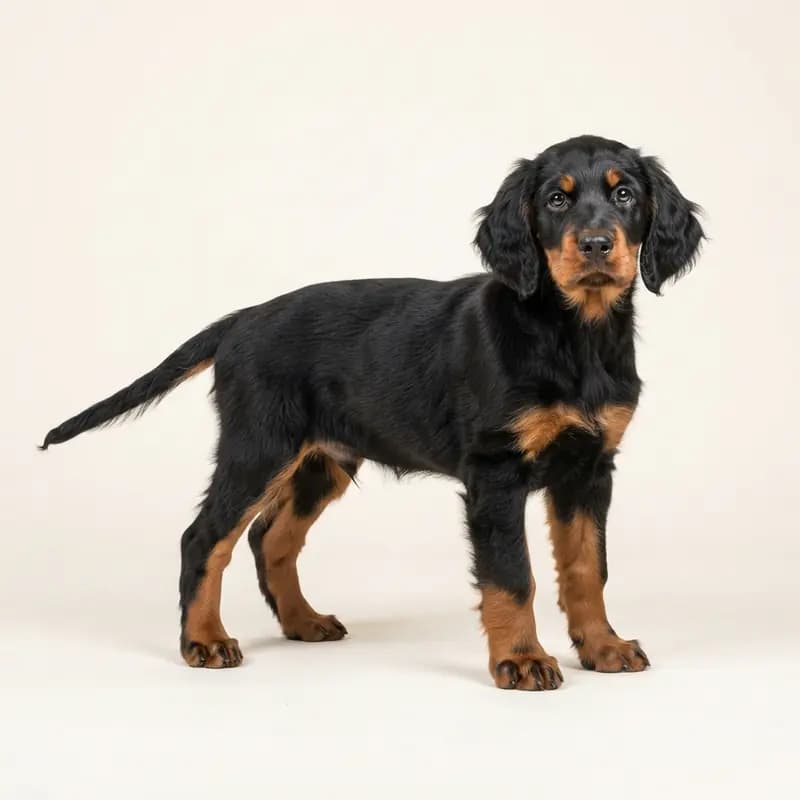
Eye colors
 Brown
Brown
Coat type
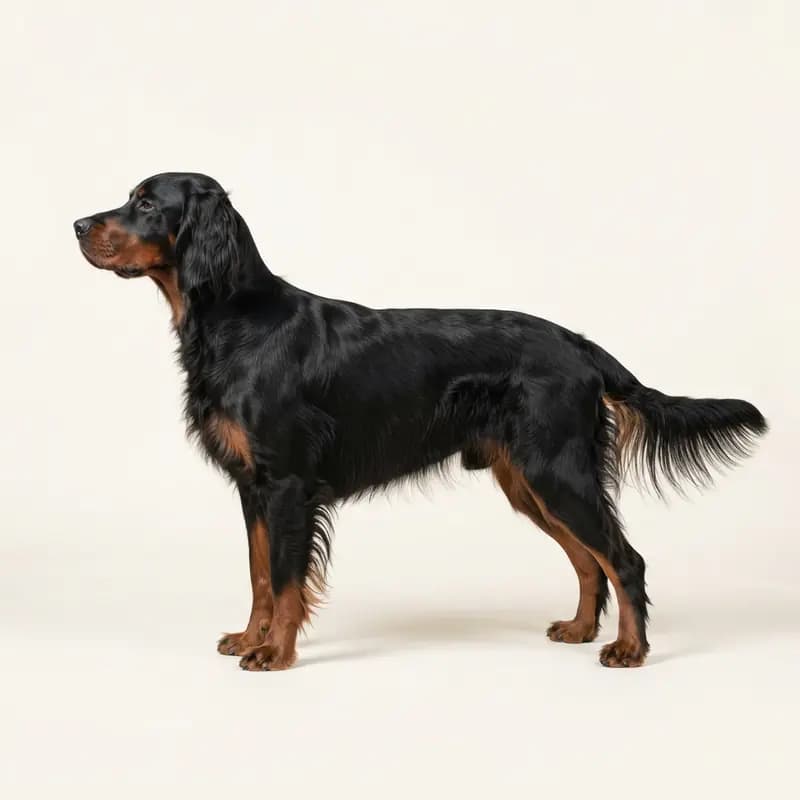 Illustrative image
Medium
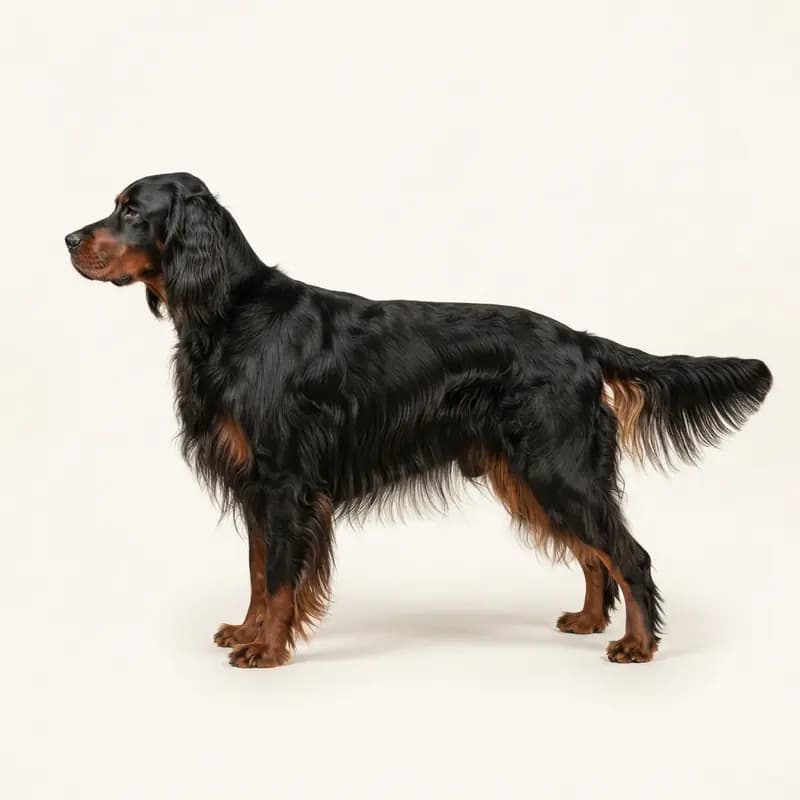 Illustrative image
Long
 Smooth
 Silky
Silky
Is the Gordon Setter right for you?
The Gordon Setter is an elegant, high-stamina Vorstehhund (pointing dog) — bred to search vast Scottish moors and indicate game by freezing silently in place. This specialization in long-distance work requires refined yet very consistent guidance.
Perfect for you if:
- You are eager for daily active scent work, dummy training, or tracking — a simple walk is not enough to mentally tire out this long-legged specialist.
- You ideally live in a rural area and can offer him safe off-leash time in open terrain or confident training on a long line.
- You bring a sensitive, patient leadership style, as this Scot reacts to harshness or unfairness by stubbornly shutting down.
- You understand that he is a late bloomer and often needs three years to truly reach mental maturity.
Less ideal if:
- You expect your dog to constantly stick to your leg while outdoors — he was bred to independently search the terrain in a wide radius.
- You live in the middle of the city and can mostly only offer him short-leash walks around the block in his daily life.
- You have little time and are looking for a dog that will wait alone in the apartment for hours every day while you work.
- You are just looking for a decorative companion and have no ambition to work with him outside in all kinds of weather.
The real vibes check
A Gordon Setter is not a dog for the side-lines — he is an athlete in a tailored suit who explodes with energy outdoors and relaxes gently indoors. When you let him off-leash, he zooms across the fields, freezes like a statue at the first scent of game, and then waits for your command. If you give him this job, you will have the most loyal shadow in the house; if you ignore his genetics, he will find his own hunt.
Self-check
Would the Gordon Setter really fit your life?
Answer 6 quick questions about your everyday life and see how well the Gordon Setter fits you — including an honest cost estimate per month, per year, and across the dog's lifetime.
Fit checkCost estimateRisk dice
Takes about 1 minute · free & anonymous
Breed Profile
There are four different breeds of setters, most of which differ in their external appearance. They all immediately catch the eye with their elegant physique and silky fur. This is underlined by the graceful and slightly springy movement. The Gordon Setters is stately and distinctive due to its dark coat color, chestnut red markings and shiny, wavy coat. A particularly striking feature is its low-hanging, feathered ears, which give its face a gentle and intelligent expression. Like the other setters, this breed is a member of FCI Group 7, which is classified as a pointer. The Gordon Setter is the most compact of the English pointers.
All measurements in detail
- Height
- 60 - 64 cm (Female), 64 - 68 cm (Male)
- Weight
- 23 - 27 kg (Female), 29 - 36 kg (Male)
- Life Expectancy
- 10 - 12 yrs
- Character
- Affectionate, intelligent, lively
- Coat
- Smooth, medium length, with a dense undercoat
- Coat Color
- Black with maroon markings
- Price
- 1500 - 2500 €
Character & Temperament
Gordon Setters are known for their gentle, friendly and even temperament. In terms of its nature, the setter is tailored exactly to what you would expect from a dog that is used for hunting in close cooperation with humans: it is agile and extremely physically resilient. The Gordon Setter values the close bond with his caregivers and, in the home environment - provided he is sufficiently challenged and exercised every day - is a fairly relaxed and comfortable companion who also feels very comfortable in families with children. Their intelligence and desire to please make them a good candidate for various dog sports and training. However, it should be noted that their high intelligence also means that they require consistent training to avoid bad behavior. Setters can be very sensitive, which is why consistency should never be confused with a hard hand! Despite their gentle and loving nature, they also have a lot of temperament and endurance. Their innate hunting instinct might lead them to chase or harass smaller pets. You should also be sure that your setter listens well to the callback and does not hunt independently if you let him run without a leash. To ensure that your daily walks remain relaxed, you should give your setter a good physical and mental workout so that he is not constantly on the hunt for tracks, but instead concentrates on you. Setters are extremely people-oriented and do not like to be alone. It is important to practice staying alone for short periods of time at a young age to avoid separation anxiety. A Gordon Setter is generally not a typical guard dog. They are usually very friendly and open-minded towards strangers and do not tend to aggressively defend their territory. However, their vigilance and attentive nature can make them good alerters when something unusual happens in their environment.
| Trainability Bred to work closely alongside humans. | Highly trainable |
| Watchfulness Occasionally alerts but is fundamentally open. | Low |
| Openness to Strangers Warms up quickly and is generally welcoming. | Friendly |
| Hunting or Herding Drive This drive runs deep — no amount of training eliminates it. | Very strong |
Fun Fact!
Did you know that Gordon Setters are known for their distinctive eyebrows, which give their expressive eyes a special charm?
What Awaits You
Gordon setters are friendly, energetic dogs with a good nose. They need a task and lots of exercise.
Housing & Care
Setters are active dogs and therefore need plenty of space to run around and play. They are particularly happy when they can enjoy their garden together with their humans and take long walks in nature. Setters are generally good with children, but because of their size and activity, they should always be supervised to avoid accidents. They also tend to get along well with other pets, including cats, as long as they have been properly socialized and do not view them as objects of hunting. Due to its energy and desire to move, this breed is best suited for active people who like to spend a lot of time outdoors and rarely leave their four-legged friend alone. You should also already have dog experience, as Setters need loving, consistent training.
- Family Friendly
Loves family life and thrives in a group.
Family-oriented - Child Friendly
Takes boisterous and affectionate children in its stride.
Patient with children - Dog Friendly
Usually gets on fine with other dogs.
Generally tolerant - City Friendly
Can manage in the city, but only with very active owners.
Difficult in cities
Owning a dog is a privilege, but it's also a real responsibility. Before you bring one into your life, be honest with yourself about the commitment it takes.
Training & Education
Gordon Setters are intelligent dogs that respond well to training. They need positive reinforcement and gentle but consistent training to be happy and well-adjusted. The active Gordons should receive enough exercise and mental stimulation to be healthy and happy. Care should be taken not to overwork them as this can lead to stress and health problems. Therefore, “switch-off training” is very important for this breed in order to train it to be a relaxed companion in everyday life. Some setters tend to become ball junkies, so playing with balls should not be overused. Instead, attention should be paid to varied games and training. Because of their hunting instinct, it is important that they learn to control their impulses and develop frustration tolerance at an early age. This can be achieved through various exercises and training sessions. The Gordon Setter benefits enormously from learning early on that he can experience "hunting fun" together with his people. Activities such as tracking, mantrailing, retrieving and stimulus fishing training are excellent examples of this. The better the dog becomes at these activities, the greater the opportunity to grant him freedom in the form of free running. At the same time, recall training should be at the top of the list of training priorities, as well as many exercises for waiting, staying and "resting". come", especially in situations with hunting attractions. At home, the Gordon Setter usually turns into a relaxed roommate who values the company of his people above all else and loves to cuddle on the sofa.
Nutrition & Care
The Gordon Setter's diet should be tailored to their energy needs. They are active dogs and therefore require a high quality diet that is rich in proteins and healthy fats. Care should also be taken to ensure that they do not become overweight, as this can put strain on their joints and increase the risk of certain health problems. Caring for the setter is a little more complex due to its long, silky coat. They should be brushed regularly to prevent tangles and to keep their coat nice and healthy. They have no undercoat and their fur is not particularly thick, so a dog coat is recommended in winter. They shed moderately, especially during the shedding periods in spring and autumn.
| Care Level Regular brushing and occasional professional grooming. | Moderate |
| Exercise Needs Working-dog energy that needs burning off every single day. | High-drive |
| Shedding Hair everywhere, always — no white clothing survives. | Very heavy |
| Trainability Bred to work closely alongside humans. | Highly trainable |
Our experts are still reviewing this information. Spotted something wrong? Email us at info@honestdog.de.
Health & hereditary diseases
Health
B
Solid
Health grade
The Gordon Setter receives a B grade because it faces health challenges typical for large hunting breeds, though these are well-managed. As with many larger breeds, hip dysplasia (HD) is a concern, but it is effectively monitored through strict selective breeding. Additionally, prospective owners should ensure that the dog has been tested for progressive retinal atrophy (PRA-rcd4) via DNA testing to prevent progressive blindness.
Grade is relative to other breeds — AI-assisted and editorially reviewed.
In daily life this can mean
You should focus on joint-friendly rearing and plan for regular eye and thyroid check-ups so that your dog stays active for a long time.
The breeder's role
Reputable breeders have the hips, eyes, thyroid, and temperament of the parent animals tested to reduce avoidable risks in the lineage.
Note: This health overview is AI-assisted and editorially reviewed. It is for orientation only and does not replace veterinary advice.
No Health Tests Available
No specific health tests are currently available for this breed.
Costs & where to find one
How much does a Gordon Setter cost?
A Gordon Setter costs around ~€190 per month (€100 – €370, depending on your setup). The first year adds up to roughly ~€5,140 including purchase, equipment and puppy school; across the dog's life (11 years) it comes to about ~€28,230.
With surgery cover, running costs come to about ~€190 per month — in return, your share of a major operation drops from several thousand euros to around 20 percent.
Per month
~€190
In the first year
~€5,140
Across the dog's life
~€28,230
Purchase from a breeder: €1,500 – €2,500
Estimate at a mid-range setup (suburban, dry food, 1–2 hours of daily exercise), average German prices, as of July 2026.
Calculate your personal costs1-minute self-check with your own answers
Looking for a Gordon Setter?
Appearance, variants & origin
History
The full history
The Gordon Setter breed originated in Scotland and is named after the Duke of Gordon, who was instrumental in its development in the 19th century. The duke bred dogs that were particularly suitable for rough pheasant hunting, placing great emphasis on endurance, sense of smell and intelligence. However, the early Gordon Setters were probably a mix of black and white setters, spaniels and pointers, and it was only over time that the black and red coat color we know today developed. In 1873, the then newly founded Kennel Club decided to introduce tricolor dogs and dogs with white parts from the "Black and Tan Setter" breed. to exclude. Finally, in 1924, the name "Gordon Setter" introduced. However, the breed's popularity only increased in the second half of the 20th century, particularly in the United States, where the Gordon Setter is now one of the most popular hunting dog breeds. After World War II, the number of Gordon Setters in Germany decreased significantly. It was not until the 1960s that the breed was restarted in Germany.
Original Use
The Gordon Setter was bred for bird hunting, particularly pointing and retrieving game birds.
Origin
Scotland
Date
1820
Owner experiences
What owners say about the Gordon Setter
Lorelay S., Halterin (Rüde, seit 2020)
Ich habe meinen Gordon Setter vor zwei Jahren als Welpen bekommen und führe ihn nicht jagdlich. Man muss sich vor der Anschaffung absolut im Klaren darüber sein, dass im ersten Jahr an Sport wie Joggen oder Wandern gar nicht zu denken ist – das hat mich anfangs ganz schön aus dem Training gebracht, weil der Kleine trotzdem extrem viel Zeit beansprucht.
Das Thema Ruhe zu Hause oder im Büro war bei uns ein hartes Stück Arbeit und hat mich anfangs viele Nerven gekostet. Erst nach einem intensiven Deckentraining und gut einem halben Jahr Arbeit hatten wir einen Rhythmus drin, sodass er heute entspannt schläft, während ich im Homeoffice arbeite oder im Restaurant sitze. Voraussetzung dafür ist aber immer eine ausreichende Auslastung.
Insgesamt sind Gordon Setter einfach tolle, im Wesen wahnsinnig liebe und ein bisschen durchgeknallte Begleiter. Man muss ihnen die Regeln aber erst mit sehr viel Liebe und Konsequenz beibringen. Im Vergleich zu den Irish Settern, die ich kenne, empfinde ich meinen Gordi allerdings als ein ganzes Stück weniger hibbelig.
Anita B., Halterin (Rüde, historische Erfahrung)
Ich war damals ein absoluter Neuling, was das Jagen angeht, und hatte keinen Jagdschein, als mein erster Gordon Setter bei mir einzog. Schnell wurde mir klar, was ich mir da für einen passionierten Vorstehhund ins Haus geholt hatte. Er war brillant darin, Wild hinterherzuhetzen, was mich anfangs oft an den Rand der Verzweiflung und des stimmlichen Zusammenbruchs getrieben hat.
Es hat uns Monate täglicher, harter Arbeit an einer 15-Meter-Feldleine gekostet, um ihm beizubringen, dass Hasen und Rehe tabu sind. Bei einem so kräftigen Hund ist das echte körperliche Arbeit, zumal ich Hilfsmittel wie Stachelhalsbänder oder Teletakt strikt ablehne. Später haben wir das Vorstehtraining aufgebaut, was wunderbar klappte, aber der Weg dorthin erfordert unendlich viel Geduld.
Wer sich einen Gordon Setter anschafft, sollte wissen, dass man diese Hunde nicht einfach nur nebenher laufen lassen kann. Sie sind hochpassionierte Arbeitstiere, die eine klare Aufgabe und eine konsequente, aber liebevolle Führung brauchen, um ihre Triebe in geordnete Bahnen zu lenken.
Geschwisterteil eines Halters aus Niedersachsen (Rüde, Erfahrungsbericht)
Meine Schwester hat sich einen Gordon Setter aus einer Show-Linie geholt, weil sie einen familienfreundlichen, menschenbezogenen Begleiter für große Wanderungen gesucht hat. Leider wurde das Erbe dieser Rasse bei uns zu einem riesigen Problem, das man nicht unterschätzen darf. Auch wenn sie nicht aus einer jagdlichen Leistungszucht stammen, steckt in diesen Hunden über Generationen selektierte Jagdpassion.
Sobald unser Rüde draußen Wild riecht, ist er absolut nicht mehr leinenführig. Ein entspannter Spaziergang ist dann Fehlanzeige. Er ist im Grunde ein Vollblutarbeitshund, der als unterforderter Familienbegleiter einfach unglücklich und extrem unruhig ist.
Wer sich für einen Setter entscheidet, muss von Anfang an bereit sein, intensiv zu trainieren und dem Hund einen echten jagdnahen Ausgleich wie Mantrailing, Dummyarbeit oder Fährtenarbeit anzubieten. Ohne diese Beschäftigung holt sich der Hund seine Auslastung selbst, was im Alltag sehr anstrengend wird.
Paraphrased from real owner reports
Loading owner stories
Community Posts
FAQ & more
Frequently asked questions about the Gordon Setter
Is a Gordon Setter the right dog for me?
The Gordon Setter is an active dog that needs plenty of exercise and mental stimulation. Research the temperament, grooming needs, and space requirements before deciding.
How long does a Gordon Setter live?
The average life expectancy of a Gordon Setter is 10-12 years. With proper care and regular vet visits, your dog can live a long, healthy life.
How much grooming does a Gordon Setter need?
Gordon Setter grooming requirements include regular brushing, nail trimming, and dental care. HonestDog provides detailed grooming tips for every breed.
Is a Gordon Setter good for families with children?
The Gordon Setter can be a great family dog. Proper training and socialization are key. HonestDog provides family suitability information for every breed.
What colors does the Gordon Setter come in?
The Gordon Setter comes in these colors: Black and tan, Red. Colors that fall outside the breed standard are marked as such on the breed page.
Loading related articles
Are you a Gordon Setter breeder?
Showcase your kennel on HonestDog and reach families searching for a responsibly bred Gordon Setter.
Why HonestDog?
What makes HonestDog different from other platforms
Full transparency
We lay out what we have: who the breeder is, how they work, and any health records they've uploaded. So you can judge for yourself.
Responsible breeding, assured
Every breeder on HonestDog has their identity and documents checked before their profile goes live. Health records they upload are shown on the profile, so you can see exactly what has been tested.
Trust and verification
We verify breeders and buyers alike, so every conversation happens on solid ground. It's a new standard of trust in dog breeding.
Less hassle, more time
We've already checked the breeders' documents and gathered the details, so you can skip the endless research and focus on finding the right puppy for your family.
Our Mission

We connect dog lovers with responsible breeders and shelters to ensure every dog finds the perfect home.
Founded by dog enthusiasts, our platform focuses on ethical dog breeding and adoption.
Why HonestDog?
We connect you with vetted breeders and shelters so you can find your — your new companion — with confidence.
Vetted Partners
Only verified breeders and shelters — for a safe start.
Highest Standards
Every animal's health and wellbeing is our top priority.
Guides & Resources
Guides, checklists, and breed profiles — so you can make a well-informed decision.